
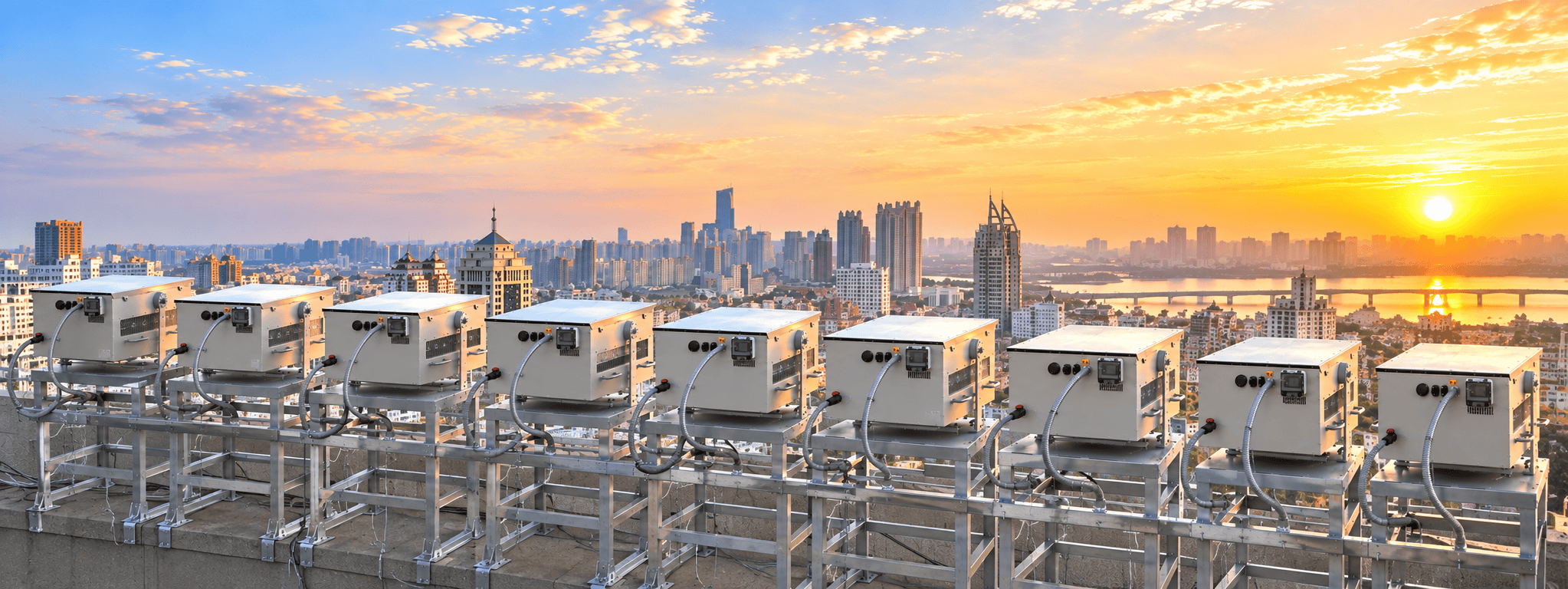
Laser Light Power Stability Test: How to Measure Real Output Power
A laser light's power is never just one number. The nameplate says 10W, but what comes out of the output window may be 8W — or only 6W. Those missing watts decide whether the light is bright enough on show night.
1. Which Power Are We Talking About?
Laser power is the radiant energy delivered per unit of time, measured in watts. The test method follows GB/T 13863-2011, the Chinese national standard for laser radiation power and power instability testing. The real question is: where do you measure it?
Inside the housing there may be a dozen laser diodes rated at 1W each. Add them up and you get 10W — but that is the number on paper, at the chip level.
On its way from the diodes to the output window, the beam passes dichroic combining mirrors, beam expander, collimating lens, window glass and galvo scanner mirrors — six to ten optical surfaces, each taking a few percent. A beam-combining efficiency of 85% is good; poor designs only reach 70%. So for a light rated at 10W, 8W at the output window is normal, and 6W is not unusual.
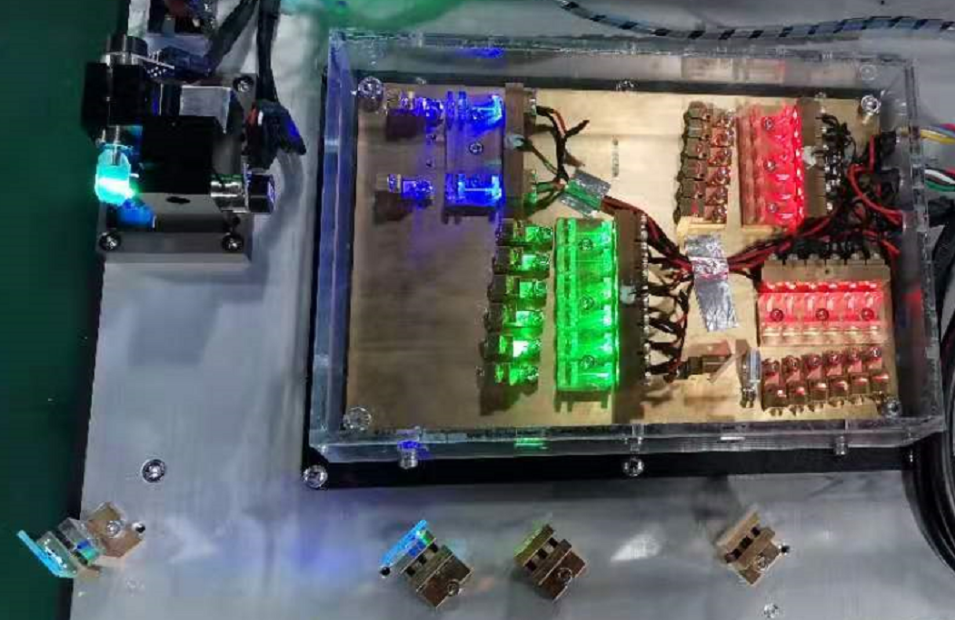
Laser modules during beam-combining alignment on the optical bench
2. Three Common Power Problems
Overstated ratings
The nameplate simply adds up the rated power of every laser diode. It has nothing to do with the actual output.
Diode power counted, optical losses ignored
Customers have reported output-window power 10%–20% below the rated value. The higher the rating, the bigger the gap.
Cutting corners on the RGB ratio
Blue diodes are cheap, so stacking blue is the lowest-cost way to reach a power figure. Green is expensive, so green gets cut. The total adds up, but the colour leans blue and the brightness doesn't follow. In one extreme case a customer told us about, a 30W RGB light delivered 18W of blue — close to 60% of the total.
3. Enough Watts, Not Enough Brightness — Why?
The human eye is far more sensitive to some wavelengths than others. According to the CIE 1924 photopic luminous efficiency function, 1W of green contributes roughly 18 times more perceived brightness than 1W of blue.
Push blue up to 60% and the power number looks impressive, yet perceived brightness barely moves and the image looks dull.
To judge whether an RGB ratio is right, you can't look at power share alone.
4. How to Measure with a Power Meter
Watt-level laser lights can easily damage low-range photodiode sensors, so use a thermal sensor with a suitable range. We follow five steps:
Warm up. Run the light continuously for 30 minutes and record only once the reading is stable.
Capture the full beam. The spot must fall completely within the sensor's active aperture. Switch to a larger sensor rather than clip the edge.
Fix the distance. Measure in the near field, 200–300 mm in front of the output window.
Measure each colour. Turn on R, G and B individually and measure each one, then turn all three on together for total power.
Keep records. Write the ambient temperature, sensor range and the average of three readings into the report.
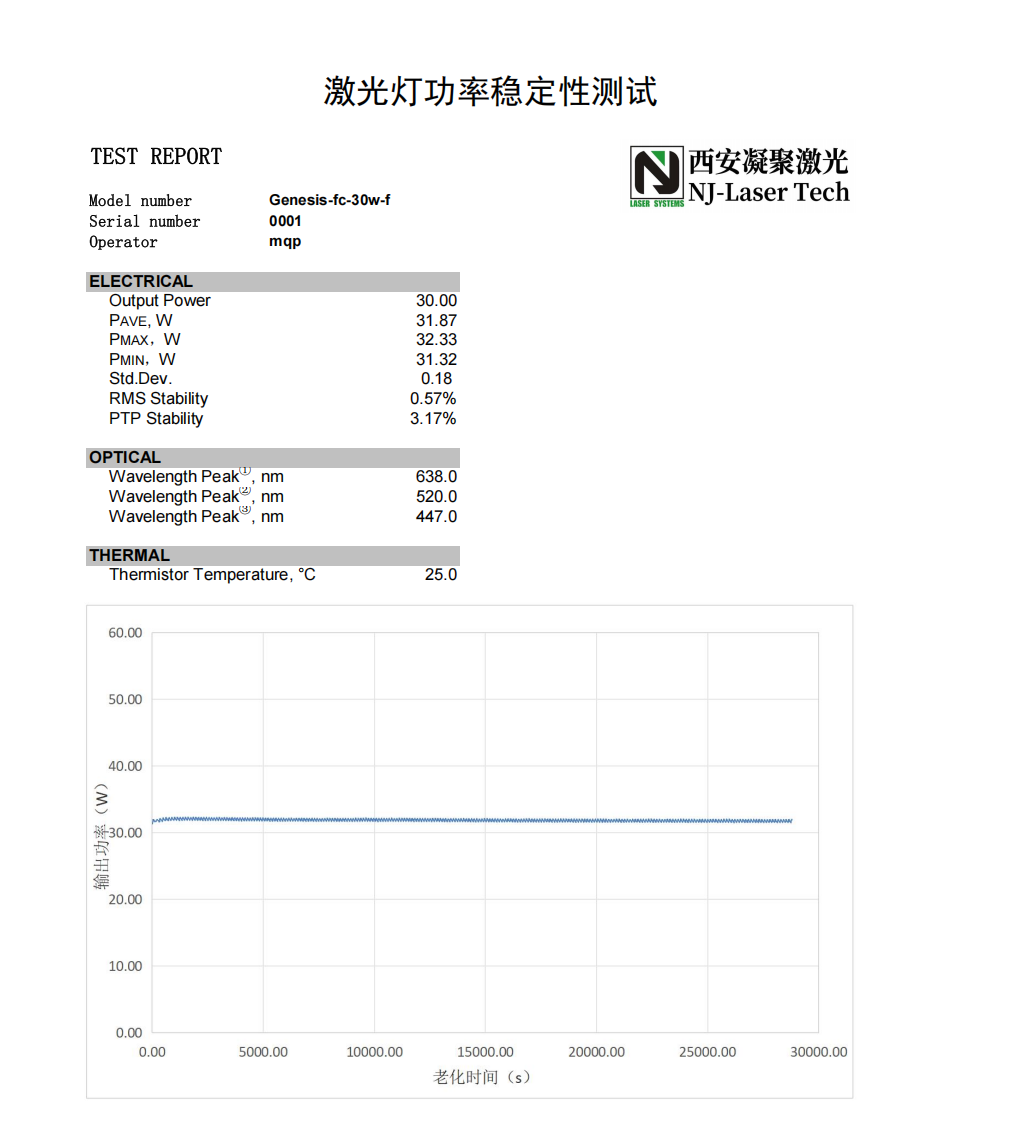
Power stability test report of an NJ Laser Tech 30W RGB laser light
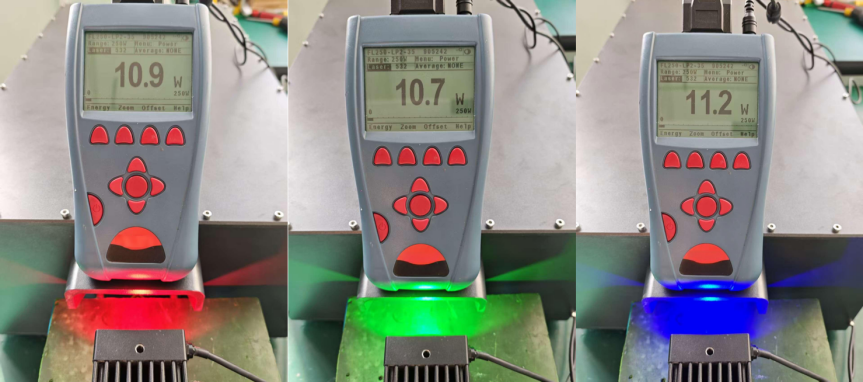
Power meter readings at the output window: red, green and blue measured separately
5. A Simple Acceptance Checklist
| Item | Criterion | Measured |
|---|---|---|
| Total output-window power | ≥ rated power × lower bound of beam-combining efficiency | 32.4W |
| Per-colour power R / G / B | Record each colour and compare with the design ratio | R 10.9W / G 10.7W / B 11.2W |
6. Three Takeaways
Before you buy, measure at the output window — don't trust the nameplate alone.
The RGB ratio should account for visual perception, not just power share.
Ask your supplier for a per-colour measured power report. If they can't provide one, they probably know why.
Measured at the Output Window
At NJ Laser Tech, we measure power where it matters — at the output window, colour by colour — as shown in the test report above. Learn more about our quality control and testing.
Related Products
Need a per-colour test report for your project? Ask our engineers.